

Can Multilateralism Be Re-Invented?
Elizabeth N. Saunders (Columbia University), Jean-Marie Guéhenno (SIPA, Columbia University), Tim Heinkelmann-Wild (LMU Munich, EUI) Moderator: Emmanuel Kattan (Columbia University)
16.09.2026 – 17.09.2026
18:00 – 20:00
Hybrid : Deutsches Haus, 420 West 116th Street, New York, NY 10027 /!\ New York time: September 16, 6:00 p.m. & Online
Sprache: DE / FR / EN
Zur Anmeldung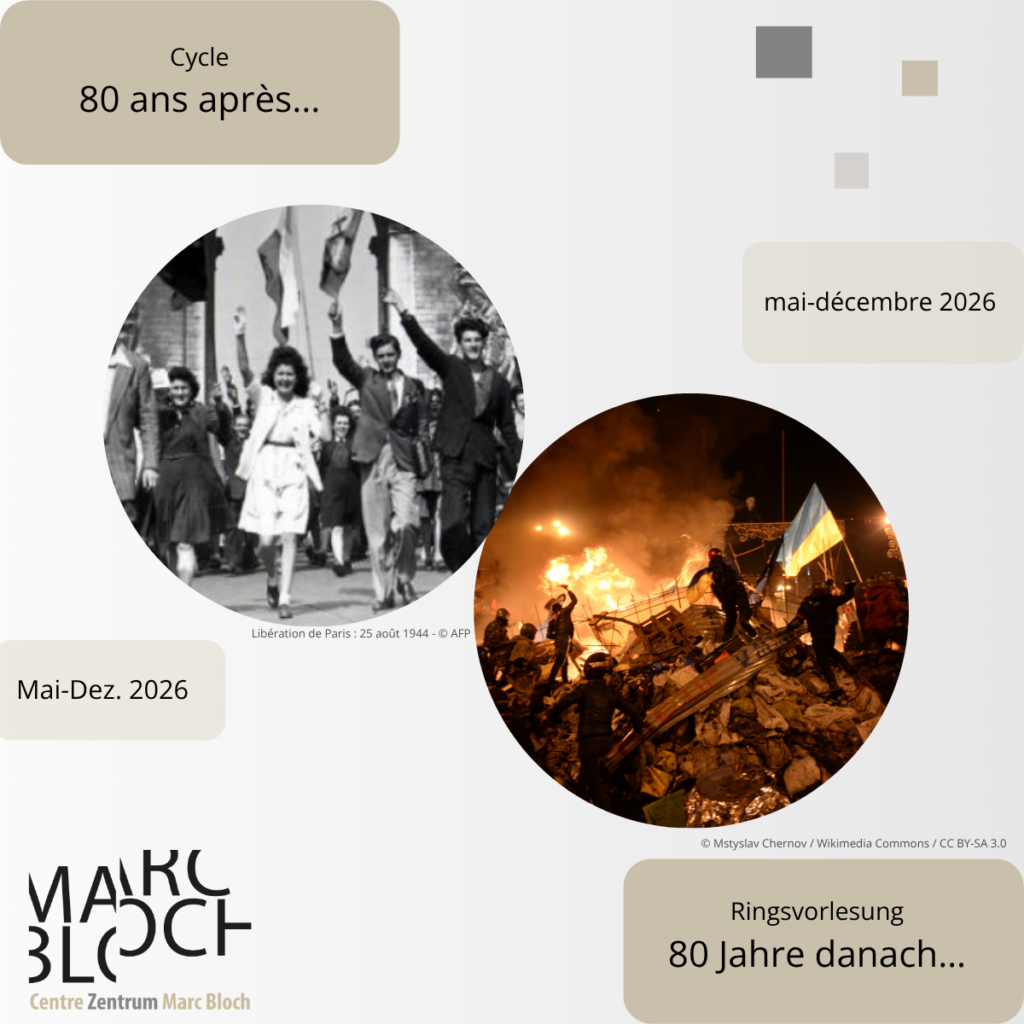
A panel discussion presented by the Marc Bloch Center, the Alliance Program, and Deutsches Haus, Columbia University
The world order that emerged out of World War II helped affirm the power of diplomacy and the need to uphold international law. But it wasn’t perfect. Countries in the Global South did not always reap the benefits of the multilateral system, which often favored the most powerful countries. Today, the post-World War II order is cracking at the seams and we are experiencing a return to power politics and a „might is right“ ideology. While many support some of the achievements of the past decades—international collaboration that led to advances in science, health, human rights, gender equality, and socio-economic development—trust in the institutions and the global architecture behind this progress is waning.
What is left of multilateralism, and can it be reinvented? Is the current geopolitical and economic fragmentation inevitable? Will international cooperation give way to a patchwork of regional coalitions and issue-specific alliances, or can new forms of global governance emerge? Could coalitions of middle powers help shape a more stable and more equitable international order?
In order to examine these questions and to cast not only the future of multilateralism but also the historical foundations upon which it still rests, the Alliance Program and the Centre Marc Bloch are bringing together a transatlantic panel of expert.
Listen to the audio recording of the panel discussion on the Archives Marc Bloch
Panelists:
Elizabeth N. Saunders, Professor of Political Science at Columbia University
Jean-Marie Guéhenno, Kent visiting professor in conflict resolution, SIPA, Columbia University
Tim Heinkelmann-Wild, Lecturer, Geschwister-Scholl-Institute of Political Science at LMU Munich; Max Weber Fellow at the European University Institute (EUI)
Moderator:
Emmanuel Kattan, Director Alliance Program; Lecturer, French Department, Columbia University
This event is part of the „80 Years Later“ series, an interdisciplinary lecture program organized by the Centre Marc Bloch in order to reflect on the legacy of the international order established in 1945 at a time when its legal, political and moral foundations are being profoundly challenged. Inspired by Marc Bloch’s historical method, each session adopts a regressive perspective: starting from contemporary issues—armed conflicts, international justice, geopolitical realignments, contested memories, or democratic crises—it asks what remains of the post-1945 order and how the present reshapes our understanding of its legacy. Bringing together historians, political scientists, legal scholars, sociologists and other specialists, the series seeks to foster dialogue across disciplines and national traditions in order to better understand Europe in a period of accelerated transformation while situating it within broader global dynamics. The series is held in French, German and/or English, in a hybrid format, reflecting its commitment to international and interdisciplinary exchange.
The Speakers:
Elizabeth N. Saunders is Professor of Political Science at Columbia University. Her research and teaching interests focus on international security and U.S. foreign policy, including the presidency and foreign policy, and the politics of using force. Prior to joining Columbia, she was a professor at the School of Foreign Service at Georgetown University. She is also a non-resident senior fellow at the Brookings Institution. Her first book, Leaders at War: How Presidents Shape Military Interventions, was published in 2011 by Cornell University Press and won the 2012 Jervis-Schroeder Best Book Award from APSA’s International History and Politics section. Her new book, The Insiders‘ Game: How Elites Make War and Peace, is forthcoming at Princeton University Press in 2024. She has previously been a Stanton Nuclear Security Fellow at the Council on Foreign Relations; a fellow at the Woodrow Wilson International Center for Scholars; a postdoctoral fellow at the Olin Institute for Strategic Studies at Harvard University; a Brookings Institution Research Fellow in Foreign Policy Studies; and a National Science Foundation Graduate Research Fellow. She holds an A.B. in physics and astronomy and astrophysics from Harvard College; an M.Phil. in international relations from the University of Cambridge; and a Ph.D. in political science from Yale University.
Jean-Marie Guéhenno has come back to Columbia as the inaugural Kent visiting professor in conflict resolution. Guéhenno first came to SIPA in 2010 to serve as the Director of the Center of International Conflict Resolution and the Associate Director of the Arnold A. Saltzman Institute for War and Peace Studies. He left in 2014, when he was appointed President and CEO of the International Crisis Group. He is now a member of the U.N. Secretary General High-Level Advisory Board on Mediation. Guéhenno previously served as United Nations Under-Secretary-General for Peacekeeping Operations from 2000-2008. In that role, he led the largest expansion of peacekeeping in the history of the UN, overseeing approximately 130,000 staff on eighteen missions. Before joining the United Nations, Guéhenno served as director of policy planning in the French Ministry of Foreign Affairs, ambassador to the Western European Union, and chairman of the French Institute of Higher Defense Studies. Guéhenno has published articles in many newspapers and magazines, including „The Impact of Globalisation on Strategy“ in the International Institute for Strategic Studies‘ Survival, „Globalisation and the International System“ in the Journal of Democracy, “United Nations and Civil Wars in Daedalus, as well as articles or chapters in Internationale Politik, Prospect, Paradoxes of European Foreign Policy, and Strategic Analysis. He is the author of the End of the Nation-State (1993). Guéhenno has also taught extensively, including as a professor at the Institut d’Etudes Politiques of Paris and at the Ecole Nationale d’Administration. Guéhenno is a distinguished fellow at the Brookings Institution; he chairs the scientific committee of the Institute for higher defense studies in Paris, and is a board member of the Carnegie Corporation, of the Stockholm International Peace Research Institute, and of his alma mater, the Ecole Normale Supérieure in Paris. Guéhenno is a graduate of the Ecole Normale Supérieure, the Institut d’Etudes Politiques, and the Ecole Nationale d’Administration (ENA).
Tim Heinkelmann-Wild is a post-doctoral researcher and lecturer at the Geschwister-Scholl-Institute of Political Science at LMU Munich and a Max Weber Fellow at the European University Institute (EUI) (September 2025-August 2026). He previously held visiting positions at the University of Cambridge’s Department of Politics and International Studies (POLIS) as well as the University of Oxford’s Nuffield College and Department of Politics and International Relations (DPIR). Tim Heinkelmann-Wild’s doctoral project “After Exit: Alternative Leadership and Institutional Resilience after Hegemonic Withdrawal” was awarded “summa cum laude” honors at LMU Munich and the John McCain Dissertation Award of the Munich Security Conference 2025. He has published in the Review of International Organizations, International Studies Quarterly, the Review of International Studies, the European Journal of Political Research, and the Journal of European Public Policy. His co-authored book “European Blame Games” was published in 2024 by Oxford University Press.
Partner:
