

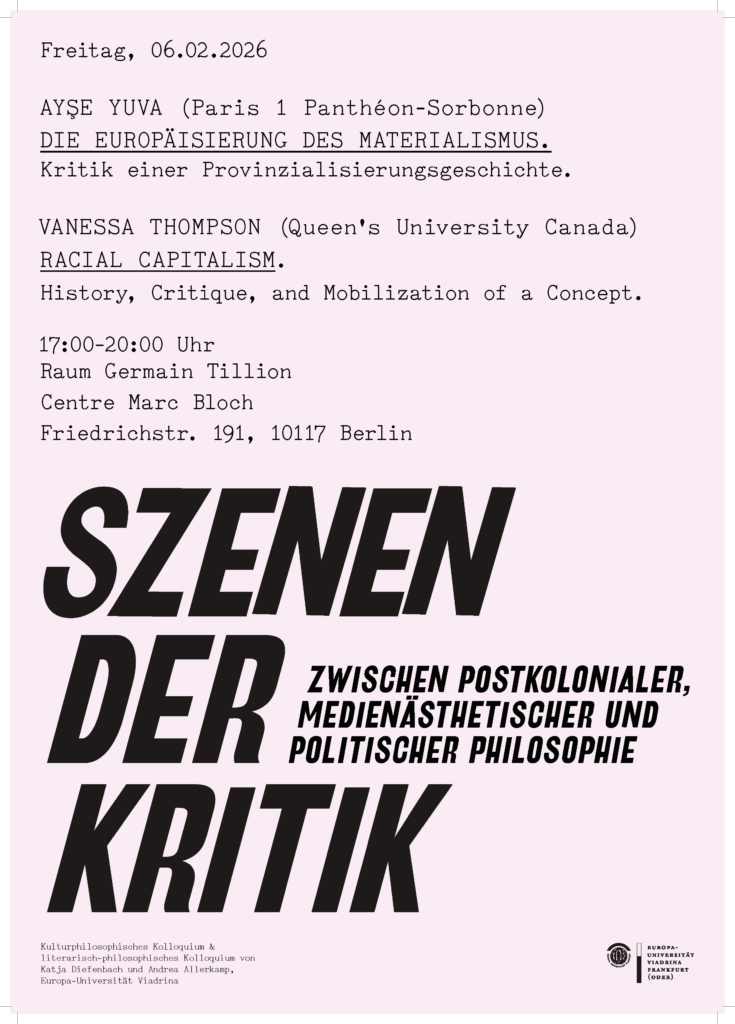
Szenen der Kritik – Zwischen postkolonialer, medienästhetischer und politischer Philosophie
mit Vorträgen von Ayşe Yuva und Vanessa Thompson
6.02.2026
17:00 – 20:00
Centre Marc Bloch, Raum Germain Tillion
In ihrem Vortrag stellt Ayşe Yuva die Grundzüge ihres aktuellen Forschungsprojekts vor, das sich mit dem Zusammenhang zwischen den Grenzen Europas und der kulturellen Identifikation des Materialismus seit dem 18. Jahrhundert befasst. Inwiefern wurde Europa seit dem 19. Jahrhundert zunehmend mit der Aufklärung identifiziert und welchen Platz nimmt der Materialismus in dieser Abgrenzung ein? Umgekehrt lässt sich fragen, inwieweit der Materialismus in seinen vielfältigen Bedeutungsebenen – ontologischer, politischer, ethischer und religiöser Art – als „europäisch und im weiteren Sinne als westlich definiert wurde. Ausgehend von diesen Fragestellungen werden kulturelle Grenzziehungen in der Philosophie analysiert und als selbstverständlich geltende theoretische Geografien untersucht. Zu diesem Zweck betrachtet Ayşe Yuva Europa nicht nur von seinem Zentrum aus, sondern auch von seinen Grenzen. Der Literaturkorpus französischer, deutscher und englischer Autoren wird um türkische Autoren des 19. und 20. Jahrhunderts erweitert.
Ayşe Yuva ist seit 2020 Maîtresse de conférences an der Philosophie-Fakultät der Universität Paris 1 Panthéon-Sorbonne und zur Zeit Gastprofessorin an der Universität Viadrina. Zuvor war sie am Centre Marc Bloch in Berlin, am IZEA in Halle und am CEFRES in Prag tätig. Mit ihrer historischen und transnationalen Analyse der französischen, deutschen und türkischen Philosophie bewegt sich ihre Arbeit an der Schnittstelle zwischen der Geschichte der Philosophie und der politischen Philosophie des 18. und 19. Jahrhunderts. Sie befasst sich mit Fragen zum Verhältnis von Theorie und Praxis in Revolutionen oder mit dem Begriff der Grenze in der Philosophie und insbesondere im Erbe des Materialismus.
Racial Capitalism. History, Critique, and Mobilization of a Concept
In the last decade, the concept of racial capitalism has gained traction in academic and various organizing spaces. Against the backdrop of anti-racist mobilizations, many organizers and scholars have turned to racial capitalism to make sense of the articulations of state racism within the current conjuncture of capitalism’s multi-crisis. While the popularity (and critique) of the concept is often reduced to Cedric Robinson’s work, its South African history (Hudson 2018, Levenson & Paret 2023) as well as its current mobilizations by scholars within and outside of the US (Gilmore 2007, Virdee 2019, Bhattacharyya 2023) are seldom acknowledged. Ignoring this multi-sited and multi-conceptual history risks concealing that racial capitalism itself is a contextual and conjunctural concept, a problem-space (Scott 1995), that entails related but distinct articulations and theorizations of the relation between race, class, and capitalism and the strategies and political struggles against it in specific historical, political, and social contexts. In her talk, Vanessa Thompson builds on the multi-sited history of the concept and engages some of its critiques based on three characteristics: the origin complex; conjunctural endurance; and relation to Marxist theory. Drawing on the work of Ruth Wilson Gilmore and Gargi Bhattacharyya, Thompson argues that a racial capitalism analysis is constructive to understand the relation between capitalist crisis, state violence, and surplusification. This relationship is mediated and legitimized by racism. To illustrate this point, she discusses several empirical accounts from Germany, France, and South Africa.
Vanessa E. Thompson is Associate Professor and Distinguished Professor for Black Studies in the Department of Gender Studies at Queen’s University in Canada. Previously, she worked as a Junior Lecturer at the Europa-University Viadrina and Goethe-University. Her work focuses on the relation between racism and state violence, as well as abolitionist resistance and internationalism. She works with abolitionist feminist movements in Europe and globally.
Organisiert von:
Kulturphilosophisches Kolloquium & literarisch-philosophisches Kolloquium von
Katja Diefenbach und Andrea Allerkamp, Europa-Universität Viadrina