

Working Lives in War-Time Ukraine
Shifting Geographies, Vulnerabilities, Resistance
22.04.2026
9:00 – 17:45
Germaine Tillion Saal (7th floor) - Centre Marc Bloch, Friedrichstraße 191, 10117 Berlin & Online
Zur Anmeldung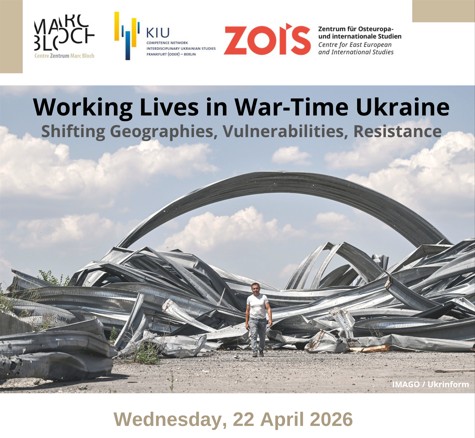
Four years after Russia’s full-scale invasion of Ukraine, this workshop examines how war has reshaped work, livelihoods, and social trajectories. It explores the effects of violence, displacement, mobilization, and destruction on everyday working lives, economic geography, and labor markets, as well as the emergence of new vulnerabilities and gendered transformations.
Focusing on under-studied sectors and skill-based social groups (e.g. agriculture, care, transport, industry, public services), the workshop also addresses diverse forms of mobility, from internal displacement to transnational migration, including those who remain in threatened areas.
Covering the period from 2014 to the present, with particular attention to developments since 2022, it adopts a multi-scalar perspective across front-line, occupied, and rear regions, as well as transnational spaces.
Organized by the Centre Marc Bloch (Berlin), ZOiS, and KIU, the workshop fosters interdisciplinary dialogue and connects research on Ukraine to broader debates on war, labor, migration, and democracy in Europe. It prioritizes fieldwork-based research and aims to highlight how labor, migration, gender, and violence intersect in everyday strategies and forms of resilience.
Organizing Team: Benjamin Beuerle (CMB), Sabine von Löwis (ZOIS), Nathalie Moine (CMB), Fabien Théofilakis (CMB), Susann Worschech (KIU Competence Network Interdisciplinary Ukrainian Studies Frankfurt (Oder) – Berlin), Tatiana Zhurzhenko (ZOIS)
Programm
Workshop : 9:00 – 17:45
9:00–9:30 Welcome & Introduction
Jay Rowell (CMB), Tatiana Zhurzhenko (ZOIS), Fabien Théofilakis (CMB), Susann Worschech (KIU)
9:30–11:00 Panel 1: Shifting Geographies
Inna Semenenko (Volodymyr Dahl East Ukrainian National University / VNG International): War-induced
business relocations: success factors, failures, and local government support (online)
Daria Malchykova (Kherson State University / Virtual Ukraine Institute for Advanced Study (VUIAS)):
Demographic Hollowing and multiple stressors of the labour market in front-line de-occupied regions
Sofia Pinedo-Padoch (Max Planck Institute for Social Anthropology Halle (Saale) / CO-HATY Ivano-Frankivsk):
Zirochka: an ethnographic portrait of building during wartime
Chair: Sabine von Löwis (ZOIS)
11:00–11:15 Coffee Break
11:15–12:45 Panel 2: To Stay or To Go
Sbigniew Szmyt Sbigniew Szmyt (Adam Mickiewicz University, Poznan): Housing-Work Nexus in Wartime: Private Hosting and the Labour Incorporation of Ukrainian Refugees in Provincial Poland
Nataliia Zaika (American University Kyiv): Staying Under Fire: Working-Age Women’s Motivations to Stay in
Ukraine During the War
Richard Pettifer (University of Melbourne / Cultural Workers Studio, Berlin): Precarious Acceleration:
Cultural Labour through the Full-scale invasion
Chair: Lidia Kuzemska (University of London)
12:45–13:45 Lunch
13:45–15:30 Panel 3: Socioecological Transformations and Critical Professions Under Fire
Iryna Zamuruieva (University of Oxford / Commons Journal): A figure of a farmer: exploring the agronomic,
entrepreneurial and manual labour it takes to grow rapeseed in war-time Ukraine
Milena Komar (National University of “Kyiv-Mohyla Academy” / Capitalent Network): The Green Transition’s
Missing Workers: Human Capital Crisis in Ukraine’s Wartime Renewable Energy Sector
Kateryna Filonova (Center for Urban History (Lviv)): Professional Identities, Social Recognition, and Institutional
Loyalty among Ukraine’s Critical Infrastructure Workers
Sophie Lambroschini (CERCEC (EHESS-CNRS)/Centre Marc Bloch): Repairing pipes and society at war. How the
‘golden hands’ of Ukraine’s infrastructure workers connect hardware, the commons and the state in wartime liminality
Chair: Benjamin Beuerle (CMB)
15:30–15:45 Coffee break
15:45–17:15 Panel 4: War-related Vulnerabilities and Resistance
Viktoria Naumenko (FernUniversität in Hagen): Between “Before” and “After”: Continuity and Interruption of
Work under Occupation (case Vilcha village, Kharkiv region)
Daryna Korkach (Kyiv School of Economics / “Gender in Detail“): Invisible Shifts: Women’s Care Work and
Wartime Labour in Ukraine since 2022
Inha Kozlova (Ukrainian Catholic University, Lviv): Returning to Civilian Life: Employment Challenges and
Pathways for Ukrainian Veterans (online)
Chair: Simon Schlegel (Center for Liberal Modernity in Berlin)
17:15 – 17:45 Final discussion & outlook
Concluding remarks : Nathalie Moine (CMB)
18:00 – 19:30 ROUNDTABLE with journalists
How to inform on Ukrainian Lives in Front-Line and occupied area (Chair: Susann Worschech, KIU)
Gwara (TBA) (ONLINE), Viktoriia Hubereva (Rubrika, UWEC) (ONLINE), Peggy Lohse (dekoder.org, taz, MOZ/SWP),
Valeriia Semeniuk (Tagesspiegel), Olesya Yaremchuk (INDEX) (ONLINE)
Chair: Susann Worschech, KIU
Photo : Hangar granary destroyed by Russian shelling near Orikhiv in the Polohy district, Zaporizhzhia region, Ukraine, on July 8, 2025. ©Dmytro Smolienko Ukrinform/IMAGO
