

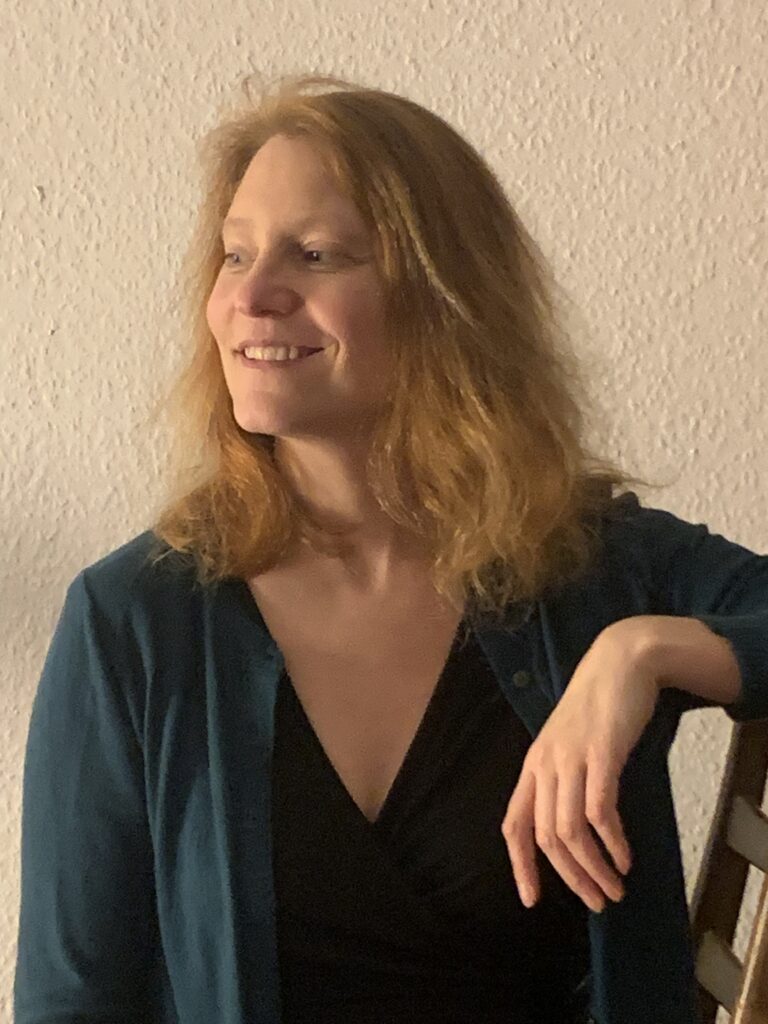
Aurélia Kalisky
VITA
Biografie
Aurélia Kalisky studierte Vergleichende Literaturwissenschaft und Allgemeine Literaturwissenschaft an den Universitäten Paris-Sorbonne (Paris IV) und Sorbonne Nouvelle (Paris III). 2013 promovierte sie an der Université Sorbonne Nouvelle – Paris 3 mit einer Dissertation zum Thema Vom Zeugnis zum testimonialen Erzeugnis. Für eine Kulturgeschichte des Testimonialen (Recht, Geschichte, Philosophie, Literatur).
Von 2012 bis 2021 war sie wissenschaftliche Mitarbeiterin am Zentrum für Literatur- und Kulturforschung (ZfL) in Berlin. Dort entwickelte sie interdisziplinäre Forschung zu Formen politischer Gewalt, Literatur und Zeugenschaft, den Historiografien von Genoziden und Verbrechen gegen die Menschlichkeit sowie zu Erinnerungskulturen und Erinnerungspolitiken. Sie war unter anderem am DFG-Projekt Zeugenschaft: Ein umstrittenes Konzept, untersucht im Austausch zwischen systematischer und kulturgeschichtlicher Perspektive (2012–2016) beteiligt und leitete das deutsch-französische DFG-ANR-Projekt Premiers modes d’écriture de la Shoah. Pratiques savantes et textuelles des savants survivants juifs en Europe (1942–1965) (2017–2021).
Forschungsaufenthalte und Fellowships führten sie unter anderem an das Simon Wiesenthal Institute in Wien, das NIOD Institute for War, Holocaust and Genocide Studies in Amsterdam, das Moses Mendelssohn Zentrum in Potsdam sowie an das Käte Hamburger Kolleg CURE der Universität des Saarlandes.
Seit 2025 leitet sie gemeinsam mit Kolleg am Centre Marc Bloch das deutsch-französische DFG-ANR-Projekt FIMEMO (First Memories and Forms of Knowledge. Comparative Study on the Immediate Aftermath of Genocide and the First Memories, Documentation Projects, Memorial and Material Practices, and Forms of Knowledge in the Cases of the Shoah and the Genocide of the Tutsi in Rwanda). Das Projekt wird in Kooperation mit dem Zentrum für Antisemitismusforschung (Technische Universität Berlin) sowie weiteren Partnerinstitutionen in Frankreich und Ruanda durchgeführt.
Ihre Forschungsschwerpunkte liegen auf den von Überlebenden hervorgebrachten Wissensformen nach Massengewalt, den Praktiken der Zeugenschaft, den öffentlichen Gebrauchsweisen der Vergangenheit, Erinnerungspolitiken sowie vergleichenden Ansätzen der Genozidforschung. Methodisch bewegt sie sich an der Schnittstelle von Literaturwissenschaft, Geschichtswissenschaft, Philosophie, Sozialwissenschaften und Memory Studies.
Mutterinstitut:
Centre Marc Bloch (boursière)
Forschung
Forschungsthemen
Theorie und Praxis der Zeugenschaft
Literatur, politische Gewalt und Zeugenschaft
Historiografie von Genoziden und Verbrechen gegen die Menschlichkeit
Erkenntnistheorie der Geschichtswissenschaft und Wissensproduktion über Massengewalt
Von Überlebenden hervorgebrachte Wissensformen (survivor knowledge) und frühe Formen der Erinnerung
Geschichte und Politik der Erinnerung
Öffentliche Geschichtskulturen und Erinnerungskulturen
Geschichte des Antisemitismus, des Antirassismus und der Antidiskriminierungspolitiken
Geschichte des Holocaust- und Genozidleugnens sowie erinnerungspolitischer Kontroversen
Vergleichende Genozid- und Massengewaltforschung
Geschichte und Erinnerung des israelisch-palästinensischen Konflikts
Repräsentationen, Zeugnisse und Erinnerungskulturen im Kontext des Genozids in Gaza sowie der gegenwärtigen Debatten über die rechtliche Einordnung von Massengewalt
Forschungsprojekt
The First Memories and Forms of Knowledge (FIMEMO) project proposes to study the „first
knowledges“ produced by survivors and affected communities, including the diasporas, in the
aftermath of genocide. It focuses on the first two decades following the Shoah (1944-1964) and the
genocide against the Tutsi in Rwanda (1994-2014), and on the material and memorial practices
emerging and consolidating during that time. The objective of the project is to explore the heuristic
value of an approach that is both comparative and interdisciplinary. It puts into dialogue recent
achievements in the evolving field of aftermath studies devoted to the Shoah and the
corresponding, but still little explored, research on the genocide against the Tutsi in Rwanda. The
project engages first memories, forensic and documentation projects, and practices of knowledge
production undertaken by survivors. It thereby challenges the long-established epistemic blindness
in the fields of Holocaust and genocide studies to bottom-up, grassroots, vernacular, and activist
constructions of memory and understandings of the genocide established by the affected
communities vis-.-vis those fostered by states bodies and dominant scholarly institutions. The
comparative approach allows for a comprehensive investigation of the emergence of hybrid,
transient, and transformative practices and forms of knowledge and memory in the aftermath of
mass political violence and forms of agency reclaimed by its victims. The project seeks to reshape
existing research and conceptualisations of genocide by centring its aftermath and to reevaluate
immediate, positioned, embodied, and activist forms of memory and knowledge production through
the notion of minority epistemologies. Through an exhibition and a podcast series, it also aims to
raise awareness of the history of the genocide against the Tutsi among German academics and
the general public in Germany, France and beyond. It thus publicly intervenes in a context where
there are still few comparative studies of genocide, and where the memory of the Shoah and the
memory of colonial crimes in Africa can be perceived as mutually exclusive.
Titel der Dissertation:
Du témoignage à la création testimoniale. Pour une histoire culturelle du testimonial (droit, histoire, philosophie, littérature); Du témoignage à la création testimoniale. Pour une histoire culturelle du testimonial
Institution der Dissertation:
Université Paris 3
Betreuer*in
Carole Matheron
Publikationen
Publications
– with Nicolas Berg and Elisabeth Gallas, issue of the Journal Zeithistorische Forschungen/Studies in Contemporary History “’Sprachhandeln’ – Reflexion und Kritik der deutschen Sprache nach dem Holocaust” (forthcoming)
– German edition of the Yiddish manuscripts of Zalmen Gradowski: Die Zertrennung. Aufzeichnungen eines Mitglieds des Sonderkommandos von Auschwitz (354 p.), Berlin, Suhrkamp/Jüdischer Verlag, 2019. Translation from Yiddish into German by Almut Seiffert and Miriam Trinh. Introduction (history of the Auschwitz Sonderkommando), commentary/essay and footnotes by Aurelia Kalisky.
– with Matthias Däumer and Heike Schlie, Über Zeugen. Szenarien der Zeugenschaft und ihre Akteure, Munich, Fink, 2017.
– with Agnese Silvestri, Kalisky l’intempestif ? Relectures contemporaines d’une œuvre du XXe siècle, Francofonia 71, Fall 2016.
– With Catherine Coquio: L’Enfant et le génocide. Témoignages sur l’enfance pendant la Shoah, critical anthology (1376 p.) Paris, Robert Laffont, Collection « Bouquins », 2007.
Articles (selection)
– “Widerständige Vermittlung einer Zerstörung”. In: Frank-Lothar Kroll und Stephan Lehnstaedt (Hg.), Jüdischer Widerstand in Europa. Grundlagen, Formen, Netzwerke, Berlin, Bebra Wissenschaft, 2024, S. 199–227.
– “Sharing a Fruitful Silence: Hans Keilson and Listening to Jewish War Orphans as a Psychoanalyst and Survivor”, in Sharon Kangisser Cohen, Constance Pâris de la Bollardière, Brian Schiff (ed.), Overcoming the Darkness. Holocaust Survivors‘ Emotional and Social Journeys in the Early Postwar Period, Yad Vashem Publications
– “L’un part, l’autre reste. Parcours de savoir et itinéraires personnels de deux historiens survivants de la Shoah – Michel Borwicz, Joseph Wulf”, in Archives Juives, issue on “L’immigration juive d’Europe orientale en France au lendemain de la Shoah (1945-1954)” edited by Constance Pâris de la Bollardière and Simon Perego, Spring 2021 p. 124-158.
– “Von der Armut der Erfahrung zur Wahrheit des Zeugen”, in Magdalena Marszałek, Dominika Herbst (ed.), Testimoniale Strategien. Vom Dokumentarismus zwischen den Weltkriegen hin zu medialen Assemblagen der Gegenwart, Berlin, Kadmos, 2019, p. 43-63.
– “‘Les archives de la douleur en yiddish’ : l’odyssée d’un texte, du camp d’Auschwitz à la Knesset”, in Judith Lindenberg (ed.), Écritures de la destruction dans le monde judéo-polonais de la fin de la Seconde Guerre mondiale à la fin des années soixante, Paris, CNRS Editions, 2017, p. 209-228.
– “Silvered Water – the 1001 Reflections of an ongoing Catastrophe”, in Sybille Krämer and Sigrid Weigel (ed.), Testimony/Bearing Witness. Current Controversies in Light of Historical Perspectives and Theoretical Debates, Lanham (Maryland, USA), Rowman & Littlefield, 2017, p. 223-244.
– “Die Erzeugung der Wahrheit zwischen Kunst und Zeugenschaft. Über ein in Auschwitz geschriebenes literarisches Manifest”, in Sibylle Schmidt and Sybille Krämer (ed.), Zeugen in der Kunst, Paderborn, Fink, 2016, p. 85-106.
– “Jenseits der Typologien : die Vielschichtigkeit der Zeugenschaft” in Claudia Nickel and Alexandra Ortiz Wallner (ed.), Zeugenschaft. Perspektiven auf ein kulturelles Phänomen, Heidelberg, Winterverlag, 2015, p. 193-211.
– “D’un savoir en crise à un savoir indiscipliné. Le statut du savoir de la victime de violence de masse dans les pratiques judiciaires et historiographiques”, in Boris Adjemian et Alexandra Garbarini (ed.), Le témoignage des victimes dans la connaissance des violences de masse, Etudes Arméniennes Contemporaines 5 (2015), p. 25-77.
– “Textur de Gedenkens, Farbe der Trauer”, in Christine Kutschbach and Falko Schmieder (ed.), Von Kopf bis Fuss. Bausteine zu einer Kulturgeschichte der Kleidung, Berlin, Kadmos, 2015, p. 242-250.
– “Ein Teufel im christlichen Kegelspiel: der Doktor in Hochhuths Stellvertreter”, in Stephan Braese and Dominik Groß (ed.), NS-Medizin und Öffentlichkeit: Formen der Aufarbeitung nach 1945, Frankfurt am Main/New York, Campus-Verlag 2015, p. 193-214.
– “Poétiques de la lisière – Les textes d’enfants rescapés de la Shoah, entre ‘création testimoniale’ et genre autobiographique”, in Silke Segler-Messner and Isabella von Treskow (ed.), Génocide, enfance et adolescence dans la littérature, le dessin et au cinéma, Wien, Peter Lang 2014, p. 151-182.
– “La creación testimonial, entre el arte y el testimonio”, in Nicolas Kwiatkowski (dir.), Genocide and artistic representations, in: Revista de Estudios sobre Genocidio (2014), Universidad Nacional de Tres de Febrero, Buenos Aires, p. 11-31.
– “Quand le dévoilement restaure la pudeur. Du cinéma du tueur au cinéma de la victime dans Eau argentée, Syrie autoportrait (2014)”, in Trauma et pudeur, Centre Primo Levi, Paris, Érès, p. 233-248.
– “Un roman barbare au pays de la poésie ‘après Auschwitz’. La double réception ratée du Sang du ciel en RFA”, in Anny Dayan-Rosenman and Fransiska Louwagie (ed.), Un ciel de sang et de cendres. Piotr Rawicz et la solitude du témoin, Paris, Kimé, 2013, p. 108-125.
– “D’une Catastrophe épistémologique. La catastrophe comme négation de la mémoire”, in Thomas Klinkert and Günther Oesterle (ed.), Katastrophe und Gedächtnis, Berlin/New York, De Gruyter 2013, p. 18-74.
– “Quand tremblent les pactes. Poétique(s) de l’enfance traquée”, in Adolphe Nysenholc (ed.), L’Enfant terrible de la littérature. Autobiographies d’enfants cachés, Bruxelles, Didier Devillez, 2011, p. 233-309.
– “L’écrivain qui avait perdu sa langue (l’écriture exilée de Soma Morgenstern)”, in Danièle Sabbah (ed.) L’Exil et la différence, Eidôlon 90 (2011), Presses Universitaires de Bordeaux, p. 103-119.
– “Les voix distantes. Réflexions sur les malentendus du témoignage”, in Ruth Vogel-Klein (ed.), Die ersten Stimmen. Les Premières voix. L’écriture de la Shoah en langue allemande, 1945-1963, Würzburg, Königshausen & Neumann 2010, p. 289-328.
– “Mystères de la satire. Deux romans satiriques après Auschwitz (Hilsenrath, Gary)”, in Andrea Lauterwein (ed.), Rire, Mémoire, Shoah, Paris, Éditions de l’Éclat, 2009, p. 157-176.
– “Das literarische Zeugnis zwischen ‘Gestus des Bezeugens’ und literarischer Gattung” in Peter Kuon, Silke Segler-Messner, Monika Neuhofer (ed.), Vom Zeugnis zur Fiktion. Repräsentation von Lagerwirklichkeit und Shoah in der französischen Literatur nach 1945, Wien, Peter Lang Verlag 2006, p. 37-55.
– “Avis de démolition, ou inventaire avant liquidation. Jean Améry en dialogue avec Imre Kertész”, in Jürgen Doll (ed.), Jean Améry (1912-1978). De l’expérience des camps à l’écriture engagée, Paris, L’Harmattan 2006, p. 55-83.
– “’Ces morts innombrables sont notre affaire à tous’. La mémoire de la Shoah en France, entre ‘devoir’,’travail’ et ‘politique’” in Des crimes contre l’humanité en République française, C. Coquio/Carol Guillaume (ed.), Paris, L’Harmattan, 2005.
– “Je suis comme Dieu, cette canaille : celui qui nomme, et non celui qui est nommé”, in “Cahier Imre Kertész”, L’Animal. Littératures, Arts & Philosophie 18 (2005), p. 135-156.
– “Refus de témoigner, ou chronique d’une métamorphose : du témoin à l’écrivain (Imre Kertész, Ruth Klüger)”, in Catherine Coquio (ed.), L’Histoire trouée : négation et témoignage, Nantes, Éditions de l’Atalante, 2004, p. 413-446.
– “D’un génocide à l’autre : des références à la Shoah dans les approches scientifiques du génocide des Tutsi”, in Revue d’Histoire de la Shoah 181 (2004), p. 411-438.