

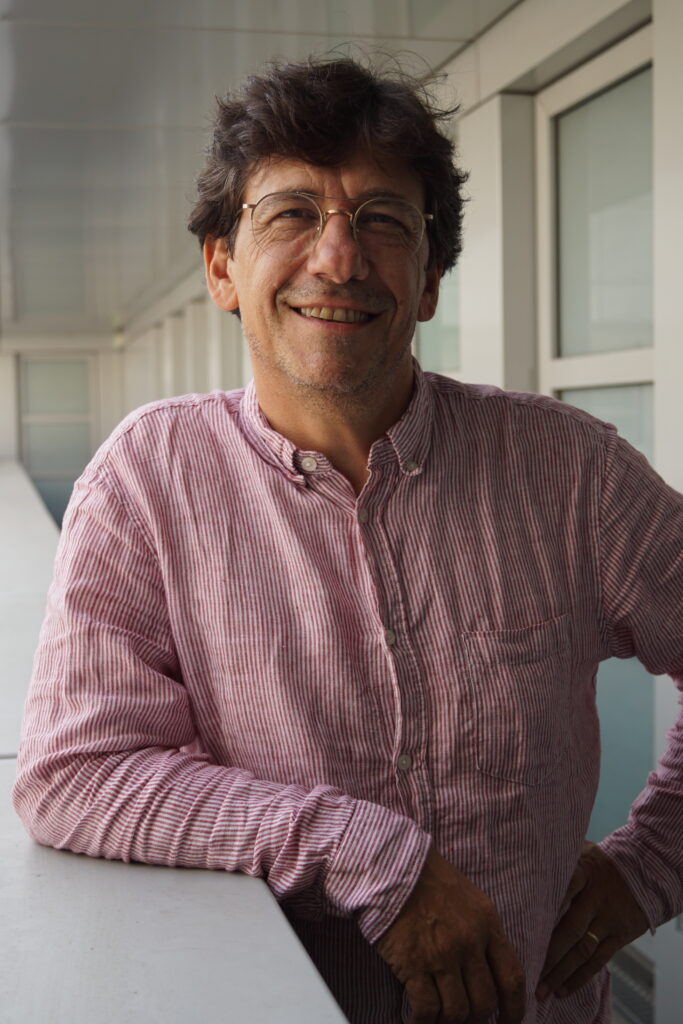
Dr Eric Wittersheim
VITA
Après un doctorat en anthropologie sociale (EHESS, 2003), Eric Wittersheim intègre en 2007 le East-West Center (institut de recherche américain basé à Hawai’i), puis l’EHESS comme maitre de conférences en 2011. Actuellement rattaché au Lap (Laboratoire d’anthropologie politique), il a auparavant été membre de l’Iris, qu’il a dirigé entre 2016 et 2018. Il a également enseigné le Bislama (pidgin du Vanuatu) à l’Inalco. Ses travaux sont consacrés à la formation de l’Etat et à la question de la souveraineté visuelle dans le Pacifique postcolonial, mais il a également enquêté sur la gentrification des cultures alternatives en France, dans le cadre de son habilitation à diriger des recherches: Anthropologie de la dépossession. Colonisations, résistances, réappropriations (2024). Titulaire de la Chaire Marc Bloch de l’EHESS pour l’année 2024-25, ses recherches actuelles portent sur les mobilisations contre le changement climatique dans le Pacifique insulaire.;
After a PhD in social anthropology (EHESS, 2003), Eric Wittersheim joined the East-West Center (a research institute based in Hawai’i) in 2007, and later EHESS as an associate professor in 2011. Currently attached to Lap ( Laboratoire d’anthropologie politique), he was previously a member of Iris, which he directed between 2016 and 2018. He also taught Bislama (pidgin from Vanuatu) at Inalco. His work focuses on nation-building and the question of visual sovereignty in the postcolonial Pacific, but he has also conducted research on the gentrification of alternative cultures in France, as part of his Habilitation à diriger des recherches: Anthropology of dispossession. Colonizations, resistance, reappropriations (2024). Holder of the Marc Bloch Chair of EHESS in Berlin for the year 2024-25, his current research focuses on mobilizations against climate change in the Pacific island nations.
Mutterinstitut:
EHESS
Forschung
Forschungsthemen
Migration, Material Desire and Climate Change in the South Pacific
Publikationen
Depuis La Présence kanak, édition critique des écrits et propos de Jean-Marie Tjibaou (avec A. Bensa, Odile Jacob 1996, trad. anglaise : ANU 2006), il a publié de nombreux ouvrages dont : Après l’indépendance. Le Vanuatu, une démocratie dans le Pacifique (2006) ;
Des Sociétés dans l’Etat (2006) ;
Luttes autochtones, trajectoires postcoloniales (avec B. Bosa, 2009) ;
Villes Invisibles. Anthropologie urbaine du Pacifique (avec D. Dussy, 2013) ;
Supporters du PSG, une enquête dans les tribunes populaires du Parc des Princes (2014) et Filmer (dans) le Pacifique (avec J. De Largy Healy, 2019).
Il a également publié une Introduction à l’anthropologie du politique (avec R. Ciavolella, 2016) et plus récemment, aux Presses de l’Inalco, Le Vanuatu dans tous ses Etats (avec M. Durand & M. Stern, 2024), un ouvrage collectif rassemblant quinze spécialistes de cet archipel considéré comme le pays le plus vulnérable au monde. En parallèle de ses recherches, il a réalisé plusieurs films ethnographiques, dont : Allers-retours à la terre (diffusé par Arte et Planète) ;
Grassroots, ceux qui votent (prix du jury au Festival du film océanien) et Le Salaire du poète (prix Bartok au Festival Jean Rouch).